Empirical studies have reinforced one of my pet philosophies. From a great little discovery of a blog, BPS Research Digest, explains "Why it's best not to expect the worst."
The study they cite doesn't point to a correlation between expectations and success as much as the link between negative expectations and negative sense of self. In other words, if you expect to do poorly, and do, you see it as further evidence of a larger personal failure. If you expect to do well, but do poorly, you don't internalize the failure, but give it an emotional shrug.
I think it goes farther than that, though. Expectations influence not only your own motivation, but also the way the world approaches you. It's a matter of energy, to sound quite postmodern about it. Positive attracts positive, negative attracts the same.
Saturday, February 11, 2006


Monday, January 30, 2006
Afterlife Telegrams--terminal volunteers deliver telegrams to loved ones on the "other side."
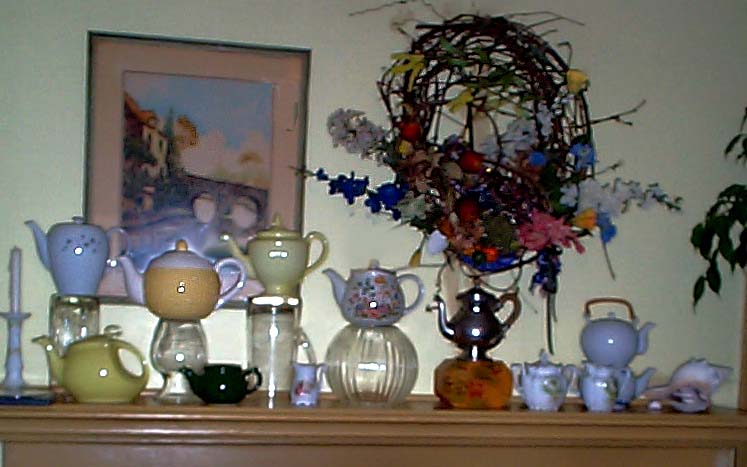
Now here's a business concept in a growth market. For just $5 a word with a five word minimum, I can tell my late Aunt Lucy about my teapot collection's newest addition. It's the round one that's bright yellow, Aunt Lucy, in case you're surfing from the afterlife.
Afterlife Telegrams
With the help of terminally ill volunteers, our service is
sending telegrams to people who have passed away.
1) The messengers have memorized their telegrams before passing on.
2) The messengers have promised to do what can be done to deliver their telegrams to the addressees after passing.
sending telegrams to people who have passed away.
For a donation of $5.00 per word (5 word minimum), we can have telegrams delivered to people who have passed away. This is done with the help of terminally Ill volunteers who memorize the telegrams before passing away, and then deliver the telegrams after they have passed away. We call this an "afterlife telegram". The $5.00 per word fee, depending on the wishes of the messenger, it is either given to a relative, donated to a charity or used to pay for medical bills. The company does not keep any of the fees from the sale of the telegrams.
Since we can not guarantee delivery nor prove that a message has been delivered successfully, our customers do not pay for "deliveries". They pay for "delivery attempts". What we do guarantee is the following:1) The messengers have memorized their telegrams before passing on.
2) The messengers have promised to do what can be done to deliver their telegrams to the addressees after passing.
Saturday, January 07, 2006
Looking for goodness, and an end to murderous smirks
Life makes some people cynical. Looking for the worst? You'll find it.
Some would have you believe their negativity and cynicism is actually hard-won wisdom, a kind of advanced degree in critical thinking. But in fact, cynicism and negativity do not add up to wisdom; rather, they add up to destructive patterns of thought that can be habit-forming.
It takes minimal cleverness and maybe seven facial muscles to produce a smirk sufficiently smirkly to paralyze creativity. We've all had ideas, work, art, children, partners, etc., all victims of murder by smirk. It's an awful feeling. Even a non-lethal injection of scorn has the power to shut down many people once and for all.
Someone recently told me that a significant percentage of us would rather be hit by a bus than speak in public. People will go to extraordinary lengths, and forgo all kinds of wonderful activities just to avoid that particular kind of dismissive disdain.
The smirk murderer gets a cheap (and fleeting) sense of superiority from the disdain they are so generous about. "Look how clever I am to have seen this thing for the drek that it is." Negativity is not a philosophy, it doesn't uplift anyone, it teaches nothing constructive, and it hurts people in more ways than we'll ever know.
One thing is for sure, a life spent avoiding smirk murders can become a kind of prison. Likewise, nothing is gained by automatically suspecting motives. Expecting the worst can attract it.
The reverse is just as true. When you face the world with an honest expectation of the goodness, the results are pretty remarkable. I've recently decided to actively look for goodness in every area of my life. I'm also consciously expecting the best from the people in my life. Results have been amazing.
I get a lot more smiles. I feel closer to people. I'm happier, much happier. Opportunities have been abundant. Life has been abundant. Energy formerly spent being fearful has been returned with dividends.
Have I ever been fooled? You bet. Have I been cheated? Once or twice. Has it been worth it? Absolutely.
Some would have you believe their negativity and cynicism is actually hard-won wisdom, a kind of advanced degree in critical thinking. But in fact, cynicism and negativity do not add up to wisdom; rather, they add up to destructive patterns of thought that can be habit-forming.
It takes minimal cleverness and maybe seven facial muscles to produce a smirk sufficiently smirkly to paralyze creativity. We've all had ideas, work, art, children, partners, etc., all victims of murder by smirk. It's an awful feeling. Even a non-lethal injection of scorn has the power to shut down many people once and for all.
Someone recently told me that a significant percentage of us would rather be hit by a bus than speak in public. People will go to extraordinary lengths, and forgo all kinds of wonderful activities just to avoid that particular kind of dismissive disdain.
The smirk murderer gets a cheap (and fleeting) sense of superiority from the disdain they are so generous about. "Look how clever I am to have seen this thing for the drek that it is." Negativity is not a philosophy, it doesn't uplift anyone, it teaches nothing constructive, and it hurts people in more ways than we'll ever know.
One thing is for sure, a life spent avoiding smirk murders can become a kind of prison. Likewise, nothing is gained by automatically suspecting motives. Expecting the worst can attract it.
The reverse is just as true. When you face the world with an honest expectation of the goodness, the results are pretty remarkable. I've recently decided to actively look for goodness in every area of my life. I'm also consciously expecting the best from the people in my life. Results have been amazing.
I get a lot more smiles. I feel closer to people. I'm happier, much happier. Opportunities have been abundant. Life has been abundant. Energy formerly spent being fearful has been returned with dividends.
Have I ever been fooled? You bet. Have I been cheated? Once or twice. Has it been worth it? Absolutely.
Thursday, January 05, 2006
Get real now or get real later, but sooner or later you must get real. Chris Locke, Jeneane Sessum, Blogging &tc.
Since I started this blog (which I have shamelessly ignored recently), I've had to defend it from time to time. Sometimes I've had to defend it rather energetically. There was concern that someone might get, ahem, pissed off, by something they might read here and, well, they might not like me. And then this little enterprise might never achieve its potential riches.
Not that this hasn't occurred to me, but my vigorous defense has been that if anyone is weird about what is written here, it would likely not be a good match to begin with. The truth will out, as they say, and life is much too short to pretend to be something you're not. It's not like anyone stands a chance of anything else coming to pass in the long run, anyhow.
How long could I realistically keep anyone convinced that I am the second incarnation of Sphincter, The Corporate Uber-Goddess, unable to sleep on the Blogging Pea Mattress? (Rhetorical question.) Then there's the other possibility. Someone might like the tiniest bit of attitude in their written word. Someone might think what they read within these pixels is exactly what they want.
I am bolstered at this point by the fact that this has actually come to pass, thank you [your favorite deity here].
So, I was reading Jeneane, ALLIED by Jeneane Sessum: Speaking Our Language (thank you for the automatic linky-script, Blogger) who wrote about an interview with Chris Locke, a strange and wonderful man who was also a blog pioneer (along with Jeneane) and one of the authors of A Cluetrain Manifesto. It's too good to truncate, and makes the point better than I was going to anyway. Jeneane wrote::
Jill again. And there it is, the terror of the creative life, rolled into one paragraph. It's the process of facing down one gaping maw of insecurity after another. But just often enough, there's a magic gleam in your inner eye, that psychedelically, exponentially takes you from zero to ten centimeters and you've got that 'la petite mort' that's as addictive as some of your better opiate derivatives. Back to our regularly scheduled quote:
"And it’s possible that, by measuring things that can be easily measured, we miss entirely the things that can’t be measured at all." How does he do that? An entire ecosystem of values contained within one elegantly succinct sentence. Certainly, indeed.
Not that this hasn't occurred to me, but my vigorous defense has been that if anyone is weird about what is written here, it would likely not be a good match to begin with. The truth will out, as they say, and life is much too short to pretend to be something you're not. It's not like anyone stands a chance of anything else coming to pass in the long run, anyhow.
How long could I realistically keep anyone convinced that I am the second incarnation of Sphincter, The Corporate Uber-Goddess, unable to sleep on the Blogging Pea Mattress? (Rhetorical question.) Then there's the other possibility. Someone might like the tiniest bit of attitude in their written word. Someone might think what they read within these pixels is exactly what they want.
I am bolstered at this point by the fact that this has actually come to pass, thank you [your favorite deity here].
So, I was reading Jeneane, ALLIED by Jeneane Sessum: Speaking Our Language (thank you for the automatic linky-script, Blogger) who wrote about an interview with Chris Locke, a strange and wonderful man who was also a blog pioneer (along with Jeneane) and one of the authors of A Cluetrain Manifesto. It's too good to truncate, and makes the point better than I was going to anyway. Jeneane wrote::
Go now and read this interview by David Newberger with Chris Locke on blogging. If there were a license to blog, this, Cluetrain and Gonzo Marketing would be the learner's permits.
Of course there is no license--no MBA, CPA, or DDS required--not even good taste, thank God. Just some skin and flesh in the game, if you're man enough to make yourself vulnerable. Because starting all of this and keeping at it is no simple thing. Or maybe it is.
[pretend this paragraph is indented five spaces to indicate quotation] The challenges of writing will present themselves immediately. And the challenges are great. Are you a fool? Are you naive? Are you saying too much? Too little? Are you bold enough to say THAT in public? Are you stupid enough? All sorts of gremlins sit on your shoulder whispering in your ear. Some are encouragements. Some are seductions. Some groundless fears. Some dangerous delusions. How a writer responds to these whisperings will determine what kind of writer he or she will become. It’s a very personal thing. My own approach is to listen carefully, then ignore all of it.
Jill again. And there it is, the terror of the creative life, rolled into one paragraph. It's the process of facing down one gaping maw of insecurity after another. But just often enough, there's a magic gleam in your inner eye, that psychedelically, exponentially takes you from zero to ten centimeters and you've got that 'la petite mort' that's as addictive as some of your better opiate derivatives. Back to our regularly scheduled quote:
While we're at it, on the notion of 'blooks,' I'd argue that the first blook was Locke's The Bombast Transcripts, featuring "browser-free" content from EGR, published in January 2002.
More nuggets from the interview:Certainly.Well, if you mean influence as it’s usually measured, then the clear answer is the Top 100 hit magnets on Technorati. No one could say, and I wouldn’t suggest, that they’re not having a lot of influence on whomever is hitting their blogs. They must, right? And the more people who hit those sites, the more people will hit those sites. In this sense, we’ve replicated the mass media model. Which is inevitable in some sense. I mean, there will always be a top-10, a top-100, in anything you can measure. It’s like fashion. Beige is the new black. Chartreuse is the new black. Whatever.
Then there’s the very different phenomenon of going to x-random site and reading something, hearing something, seeing something that changes your mind, touches your heart. It could be someone you’ve never heard of. It could be someone whose voice is just emerging. His or her real voice. Real in the sense that it cuts through all the posturing and bullshit and reminds you what you are, what we are. That kind of influence can’t be measured the same way. And it’s possible that, by measuring things that can be easily measured, we miss entirely the things that can’t be measured at all.
"And it’s possible that, by measuring things that can be easily measured, we miss entirely the things that can’t be measured at all." How does he do that? An entire ecosystem of values contained within one elegantly succinct sentence. Certainly, indeed.
Saturday, November 26, 2005
I am so embarrassed for these people
Friends, this is bad. This is really and truly bad, bad, bad. The kind of bad that makes you wince in embarrassment because, a) they really are as into it as they seem, or b), they realize how hideously humilating this is and went ahead with it to please management.
This is like a five-minute Mento's commercial, advertising gone horribly, terribly wrong. The only question more compelling than who came up with this concept, is how they got all these people to go along with public displays of such mass dorkiness. Their jobs must have hung in the balance. That's the only explanation.
via monkeyfilter
This is like a five-minute Mento's commercial, advertising gone horribly, terribly wrong. The only question more compelling than who came up with this concept, is how they got all these people to go along with public displays of such mass dorkiness. Their jobs must have hung in the balance. That's the only explanation.
via monkeyfilter
Thanksgiving Ghosts and Macabre Sightings
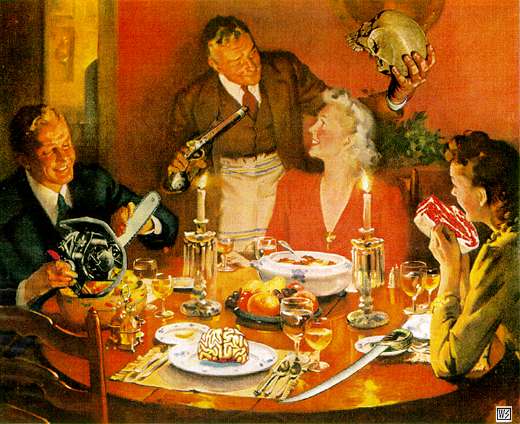
Thanksgiving is probably my favorite holiday. And while some people use the occasion to pull out all the culinary stops, I do the same thing every year. The same thing my grandmothers did. And their mothers. And on back. There is some evolution, of course, but like all evolution, it can't be observed by the naked eye.
My ancestors haunt me this time of year. It's a most pleasant haunting. As I cook the things my grandmothers cooked, I feel as much a beloved grandaughter as I ever have. I'm being nurtured as I'm nurturing, carrying on a tradition for which food is an emotional shorthand for so much more.
After the dressing is made, the cranberry relish dished into crystal, and the jello salad sparks the attention of the little ones, the family gets together for a relaxing day of feasting, grazing, chatting, walking in the woods.
This year, that Rockwellian scene took a macabre twist.
~ ~ ~
It was a brilliant sunny day with a nip in the air. After dinner, my 14-year old son, Jack, and my daughter's boyfriend, Seth, decided to get the lay of the land exploring the hundreds of acres of woods around my parents' home. They were gone for about an hour when we realized Jack, who's a Type 1 diabetic, hadn't had his shot for dinner.
Thank goodness for cell phones. We got a good idea where they were, and my husband, Daryl, went off to find them. He had Jack's insulin in his pocket and two long guns, one over each shoulder, for target practice.
A bit of backstory here. I hate guns. I'm a city girl, and to me, they serve no other purpose than to hurt people, usually innocents. I loathe violence and consider it much more obscene than even the most renegade wardrobe malfunction. But I married a small town boy. Daryl had grown up with guns as a way of life; something to be respected, surely, but certainly nothing to be feared or hated.
You can imagine which parent's philosophy has become dominant in my adolescent son. And the truth is, I'm not overly bothered by it because all they ever do is stalk the wily Coke can. He's very responsible about it and has learned enormous respect for firearms. He's not a hot dog about it in even the smallest way.
So when Jack flew into the house saying, "I shot a deer! I shot a deer!" my jaw dropped and I was suddenly inarticulate.
My sister has four kids and teaches kindergarten that has sharpened her presence of mind to the point that nothing stops her. "You realize it's not deer season, don't you? You don't have a license, Jack! That's against the law."
I regained my voice and said, "Jack, tell me exactly what happened. Every last detail. Leave out nothing.
Seth and Daryl stood at the edges, arms crossed, poker faced.
Jack pushed the hair out of eyes, relishing the attention of the entire party. "Seth and I came down the hill and we saw him. It was a beauty. Eight points, and just standing still. Seth went around one way, I went around the other, and we thought we'd corner him. We kept getting closer, and closer, and closer. The buck wouldn't move."
Then Seth broke in, "Someone had already killed it, gutted it, and had mounted its head and pelt on a tree trunk. It was all there except for its left front leg. I guess it was some kind of a decoy. There was a deer blind not far away."
Jack opened his camera phone. "Told you I shot a deer."
And sure enough, there was a grainy image of a beautiful eight-point buck in some kind of grotesque approximation of life. It was chilling to behold, but I was just grateful no one of mine had any part in it.
Thursday, November 03, 2005
Good Enough Isn't Enough Anymore
The old ways of thinking about a company's brand have changed radically. No longer can a mediocre player hire a fancy agency to pump out corporate identity, tag lines, et al, and expect it to fly. Anymore, that's as useless as socks on a rooster..
I believe this is true because we don't have room for mediocrity in our lives anymore. We don't need to put up with plain vanilla, because just down the street we can get all the savory sustenance we deserve. Our time is too valuable, our attention too distracted, our needs too urgent, to settle for anything less than authentic goodness. Isn't that great?
Depends who you are.
Products and services need to truly help people. There must be a commitment to excellence, to going the extra mile to delight your customers. That eliminates a lot of companies who have been coasting with the old paradigm for years, telling us what to believe, saying who they are rather than showing it, addicted to focus groups, where money often substitutes for forthrightness. As a people, we are demanding honesty, excellence and passion. Good for us.
So how do you communicate excellence and passion in ways that speak to the heart of the people who need what you do? (I refuse to use that old chestnut "target audience.") Snappy headlines and snazzy graphics are all sizzle and no steak without that backbone of excellence. You can fool people into a purchase, but you can't fool anyone into being a customer, let alone one who becomes your champion.
Everything you put out there has to have heart. It has to be real. It has to relay that this is not business as usual, this is humans being exceptional to one another. That doesn't mean it has to be sappy and sentimental, just the opposite, in fact. "Real" can be sober, touching, tongue-in-cheek, whimsical, or downright hilarious. It just has to be honest, excellent and passionate. That's all--just everything.
Big bucks brand advertising will not substitute for being true to your customers in every sense of the word.
So, think about this:
I believe this is true because we don't have room for mediocrity in our lives anymore. We don't need to put up with plain vanilla, because just down the street we can get all the savory sustenance we deserve. Our time is too valuable, our attention too distracted, our needs too urgent, to settle for anything less than authentic goodness. Isn't that great?
Depends who you are.
Products and services need to truly help people. There must be a commitment to excellence, to going the extra mile to delight your customers. That eliminates a lot of companies who have been coasting with the old paradigm for years, telling us what to believe, saying who they are rather than showing it, addicted to focus groups, where money often substitutes for forthrightness. As a people, we are demanding honesty, excellence and passion. Good for us.
So how do you communicate excellence and passion in ways that speak to the heart of the people who need what you do? (I refuse to use that old chestnut "target audience.") Snappy headlines and snazzy graphics are all sizzle and no steak without that backbone of excellence. You can fool people into a purchase, but you can't fool anyone into being a customer, let alone one who becomes your champion.
Everything you put out there has to have heart. It has to be real. It has to relay that this is not business as usual, this is humans being exceptional to one another. That doesn't mean it has to be sappy and sentimental, just the opposite, in fact. "Real" can be sober, touching, tongue-in-cheek, whimsical, or downright hilarious. It just has to be honest, excellent and passionate. That's all--just everything.
Big bucks brand advertising will not substitute for being true to your customers in every sense of the word.
So, think about this:
- What makes what my company does different, and how can we be better?
- How does we help people live better lives?
- Do we have stories I can tell that communicate the real truth of the heart of my business?
- Are we willing to be different from ourcompetition, not just to break through the clutter, but to deliver the best to our customers?
- Are we willing to stand out from the crowd and take the risk of not being everything to everybody? (A losing proposition any way you cut it.)
- Do we listen carefully to our customers/clients/users?
- Are our communications worthy of the heart and soul we've put into the business?
Tuesday, November 01, 2005
Which is more distracting, e-mail or pot?
You know when you see a question like that, the answer has to be e-mail. Otherwise no one would ask the question. Read more on lifehacker.com.
There is something really seductive about that little "bing" signalling new e-mail that's hard to resist. What I've done is set my controls so I have to manually get my e-mail to download. That way, it doesn't interrupt my stream of consciousness, or take me on a digression that lasts the morning. Does that mean that it's okay for me to fire up a doobie? Yeah, right.
There is something really seductive about that little "bing" signalling new e-mail that's hard to resist. What I've done is set my controls so I have to manually get my e-mail to download. That way, it doesn't interrupt my stream of consciousness, or take me on a digression that lasts the morning. Does that mean that it's okay for me to fire up a doobie? Yeah, right.
Saturday, October 29, 2005
10 Things Clients Want
From lifehacker.com:
With any business or type of work - you have to deal with customers directly or indirectly. Focusing on customer relationship and make sure your products and services are working for them goes long ways to keep your job around. Pat Matson Knapp has written an article on Joe Grant’s “Top 10 List of Client Wants”. All of them can apply to direct customer relationship, and some of them can apply when you indirectly dealing with customers:
- Keep the Principal Involved
- Communicate Effectively
- Be Easy to Work With
- Exceed Expectations
- Keep Your Promises
- Anticipate Their Needs
- Build a Seasoned Team
- Do Good Work
- Hold Their Hand
- Meet Their Goals
Monday, October 24, 2005
Information Overload
From www.elearningpost.com, an insight belonging strictly to our information-soaked culture. Until quite recently, it would have been quite difficult to have too much information on a given subject just because of the effort involved getting it. Today, it's important to edit input--even if it's just for the amount of time it takes to digest the information and form ideas and opinions on it. Critical thinking can happen in input mode, but most often is richer when on the other side of it.
Gerry McGovern writes about the dangers of having too much information:
Human beings are much better at dealing with scarcity than with glut. This is particularly true when it comes to information. It has long been accepted wisdom that you can’t have too much information. You can… Your future career hinges on your ability to plan ahead. Resist becoming a news junkie. Resist churning out emails and web pages. Sit back and think hard. In an age of information overload, what you don’t read—what you don’t write—is just as important as what you do.
Saturday, October 22, 2005
Don't Shave the Yak
From Seth Godin, in its entirety, just cause it's too good to truncate:
This is an apt observation in the "Getting Things Done" category that's become so pervasive. There's a fine line between "good enough isn't good enough" and "done is better than perfect." I've found myself arguing both cases with equal vigor. The important thing is to do it, though. Without the work, there's nothing, no matter how good the reasons may be.
Don't Shave That Yak!
The single best term I've learned this year.
Apparently turned into a computer term by the MIT media lab five years ago, yak shaving was recently referenced by my pal Joi Ito. (Link: Joi Ito's Web: Yak Shaving)
I want to give you the non-technical definition, and as is my wont, broaden it a bit.
Yak Shaving is the last step of a series of steps that occurs when you find something you need to do. "I want to wax the car today."
"Oops, the hose is still broken from the winter. I'll need to buy a new one at Home Depot."
"But Home Depot is on the other side of the Tappan Zee bridge and getting there without my EZPass is miserable because of the tolls."
"But, wait! I could borrow my neighbor's EZPass..."
"Bob won't lend me his EZPass until I return the mooshi pillow my son borrowed, though."
"And we haven't returned it because some of the stuffing fell out and we need to get some yak hair to restuff it."
And the next thing you know, you're at the zoo, shaving a yak, all so you can wax your car.
This yak shaving phenomenon tends to hit some people more than others, but what makes it particularly perverse is when groups of people get involved. It's bad enough when one person gets all up in arms yak shaving, but when you try to get a group of people together, you're just as likely to end up giving the yak a manicure.
Which is why solo entrepreneurs and small organizations are so much more likely to get stuff done. They have fewer yaks to shave.
So, what to do?
Don't go to Home Depot for the hose.
The minute you start walking down a path toward a yak shaving party, it's worth making a compromise. Doing it well now is much better than doing it perfectly later.
Friday, October 21, 2005
Saturday, October 15, 2005
What’s the Most Important Word In Marketing?
Scott Ginsberg, of "Hello, My Name is Scott," fame has done a lovely job of deliniating the differences between traditional, old school marketing and new marketing by asking "What’s the Most Important Word In Marketing?"
Read his article on the subject.
Read his article on the subject.
Tuesday, October 11, 2005
Seth Godin's Free E-Book on Blogging
Seth is fun to read to begin with, and what he has to say always has a twist for a bit of edge and flavor that's earned him and his bald head the fine reputation the two of them enjoy. He's written a dandy 48-page e-book about blogging and what it's all about, why it's important, and why you might oughtta to be blogging. He's a good thinker, and he's laid it out goodheartedly for the rest of us to download for F R E E ! ! !
Do yourself a favor and download Who's There? Seth Godin's Incomplete Guide to Blogs and the New Web. It's a PDF, but worth the wait (or is that just my computer that's so dreadfully slow opening those honkers).
Spend some time at his blog, too, and find out why he bills himself as "author, agent of change."
Do yourself a favor and download Who's There? Seth Godin's Incomplete Guide to Blogs and the New Web. It's a PDF, but worth the wait (or is that just my computer that's so dreadfully slow opening those honkers).
Spend some time at his blog, too, and find out why he bills himself as "author, agent of change."
Long time, no blog
Has it really been so long since my last post? Blogs don't lie, or at least they shouldn't, so yes it has.
I have a really, really good excuse. My family has moved house from a typical suburban ranch to a funky, fun and smaller Victorian loaded with charm, not closets. There's nothing like moving and downsizing at the same time to come face-to-face with what's truly necessary. It's really a lot less than I used to think.
There's something so freeing about letting go of possessions. I still have the important things, the heirlooms from both sides of the family, the touchstones of a lifetime of complicated, wonderful living. I don't have so much stuff anymore, which means what I have is distilled to the essence. I could distill even more if I needed to. That's also a good thing to know.
Less really is more.
I have a really, really good excuse. My family has moved house from a typical suburban ranch to a funky, fun and smaller Victorian loaded with charm, not closets. There's nothing like moving and downsizing at the same time to come face-to-face with what's truly necessary. It's really a lot less than I used to think.
There's something so freeing about letting go of possessions. I still have the important things, the heirlooms from both sides of the family, the touchstones of a lifetime of complicated, wonderful living. I don't have so much stuff anymore, which means what I have is distilled to the essence. I could distill even more if I needed to. That's also a good thing to know.
Less really is more.
Tuesday, September 20, 2005
From Kottke.org
As part of his review of the recent AIGA conference, Kottke offers up the following quoted bon mot:
As part of the conference within a conference for students, Michael Bierut listed 20 courses he did not take in design school (I think I got all of them):
Semiotics
Contemporary Performance Art
Traffic Engineering
The Changing Global Financial Marketplace
Urban planning
Sex Education
Early Childhood Development
Economics of Commerical Aviation
Biography as History
Introduction to Horticulture
Sports Marketing in Modern Media
Modern Architecture
The 1960s: Culture and Conflict
20th Century American Theater
Philanthropy and Social Progress
Fashion Merchandising
Studies in Popular Culture
Building Systems Engineering
Geopolitics, Military Conflict, and the Cultural Divide
Political Science: Electoral Politics and the Crisis of Democracy
His point was that design is just one part of the job. In order to do great work, you need to know what your client does. How do you design for new moms if you don't know anything about raising children? Not very well, that's how. When I was a designer, my approach was to treat the client's knowledge of their business as my biggest asset...the more I could get them to tell me about what their product or service did and the people it served (and then talk to those people, etc.), the better it was for the finished product. Clients who didn't have time to talk, weren't genuinely engaged in their company's business, or who I couldn't get to open up usually didn't get my best work.
Bierut's other main point is, wow, look at all this cool stuff you get to learn about as a designer. If you're a curious person, you could do worse than to choose design as a profession.
Tuesday, September 06, 2005
September's Website of the Month: Word Spy
In our continuing effort to stay abreast of the latest in the ever-changing world of linguistics, please note our September Website of the Month, Word Spy.
For those of us who love us some good words, The Word Spy is quite a find. Examples of language creation, intelligent design and evolution all peacefully coexist in a cyber world where terms like "stunt words" and "lexpionage" take up the same amount of space at the dinner table as their more established cousins. After all, when dressing for a fine word salad, a well-fitting cap of stylish expressions is the perfect finish for the sartorially-minded gentlewoman's lexicon.
This website is devoted to lexpionage, the sleuthing of new words and phrases. These aren't "stunt words" or "sniglets," but new terms that have appeared multiple times in newspapers, magazines, books, Web sites, and other recorded sources.
For those of us who love us some good words, The Word Spy is quite a find. Examples of language creation, intelligent design and evolution all peacefully coexist in a cyber world where terms like "stunt words" and "lexpionage" take up the same amount of space at the dinner table as their more established cousins. After all, when dressing for a fine word salad, a well-fitting cap of stylish expressions is the perfect finish for the sartorially-minded gentlewoman's lexicon.
Wednesday, August 24, 2005
Creativity
Being creative is hard. It's very hard. Not just because you're continually forging new pathways in the brain, although that's part of it. It's the risk you take when you put your creativity out there for the world to judge. And, oh, does the world ever judge. Our world pays a lot of lip service to creativity while dashing it with disdain as often as not. We are such creatures of habit that when something new hits us, we have a tendency to reject it out of hand. Or at least that's my working theory. It's also a hell of a lot easier to tear something down than build something up.
Will we ever know how a flippant remark might diminish someone else's creative impulses? Fear of disdain is huge. So huge that swarms of humanity give up trying to be creativity because of it.
I remember the first time I ever had to present ad concepts. I was terrified. I felt like I was parading around naked. It's still that way, although I've become much more adept at weathering the inevitable criticism.
The following article discusses the inherent difficulties in the creative life with such acumen I'm exerpting it in full. "What makes me creative" by Bruce DeBoer.
Will we ever know how a flippant remark might diminish someone else's creative impulses? Fear of disdain is huge. So huge that swarms of humanity give up trying to be creativity because of it.
I remember the first time I ever had to present ad concepts. I was terrified. I felt like I was parading around naked. It's still that way, although I've become much more adept at weathering the inevitable criticism.
The following article discusses the inherent difficulties in the creative life with such acumen I'm exerpting it in full. "What makes me creative" by Bruce DeBoer.
"My 8 year old son is so creative he's going to be an artist." How many times have you heard that? Naïve art – young children are natural at it. It's the first rain in the desert, new run-off paths are spontaneously created; the water forges streams where there were none. An 8 year old discovers crayons uninhibited by life experience, ego, and deadlines. Nearly every connection is a new one. She hasn't yet learned how not to be creative.
When we say that art is immature, what do we mean? We don't necessarily mean that the artist lacks originality; more likely, we mean that its originality is born by an artist who doesn't yet know enough to be interesting, or deliver emotion in a compelling way. The moment a child realizes their art is immature, the crayons stand a good chance of being surrendered.
Information and experience are like food for the creative process. It's raw substance. Information needs to be digested to brain-fat so it can re-immerge as mature creative energy. It's as if it needs to be inculcated into our souls before we are free to randomize it into original creative expression. If we don't digest it, a creative product – art, innovation, music, etc. – is sure to be more derivative that original. Creativity is using our unique inner selves to rearrange the raw material.
Society teaches the creativity out of our students. If X, then Y is easy to teach. If X, then Y gets results. It generates tangible and immediate ROI. Do this and get that result. Take an alternative path and risk failure or – even worse – ridicule. Research creative history and learn what got rewarded and what was ignored. Teach high craft and call it high art. Creativity is too soft and round; there is nothing to grab onto. There are often no clean results to judge. Creativity is messy but we all crave the rewards.
When do we begin to fear our own creativity? I believe it is the point at which we began to market ourselves. True creativity is deeply personal because we have to create new streams – new run-off paths in our souls. Risking creative rejection is terrifying. It's rejection that cuts so deep it's worse than a High School crush laughing when you finally get the nerve to ask her to the movies (I digress, forgive me). Creativity takes courage. Being vulnerable takes guts. Needed is a willingness to be rejected for what is among the most personal of expressions. The stakes are high.
Taking a less risky path is more about fine craft than innovation. I'm reminded of advice from an emerging professional as I left college: he told me, "On the outside, there is no room for 'b" quality work." In other words: it is the end of experimentation without consequences. Experiment all you want on your own, but come to work with your "A" game: bring what you know will meet approval.
Hugh MacLeod of Gaping Void fame uses the Sex and Cash theory to explain how creativity and business relate. Re: Sex and Cash, "This tense duality will always play center stage. It will never be transcended." Creativity is sexy. The more you get paid for your creativity, the less sexy it is. I believe there are laws governing sex and cash, are there not? Do we dare go counter culture?
The occasional and often publicized young creative genius can lull us into the false impression that creativity is only for the immensely and naturally talented. "I can't do that, I've never been creative." The truth is creativity is hard work. Creative people are talented because they put in the hours. There is a passion for the doing; they can't not-do, and the results are secondary to the act but no less important than their original idea. Does this confuse you?
Whether you're an artistic temperament seeking structure or a rational temperament seeking imagination, creativity is constructive only when related to others. If you've heard improvisational abstract Jazz you know what I mean. An artist's passion can be intensely creative but the results can fail to inspire others – it's self indulgent.
Ever try to talk through your raw creative ideas with another? Sounded dim, didn't it? People often reject another's raw creativity; it's simply too intimate until it takes a form prone to mutual acceptance. Raw creative ideas aren't ready for prime time – they need at least minimal crafting. Like a beautifully written song sung out of key – poor craft masks the emotion or defeats the function.
For those of you in need of concrete illustration, this should keep you busy:
Creativity x Craft x Emotion = Art
Creativity x Craft x Function = Innovation
[This should help with the test at the end, so pay attention.]
However flawed you may find these equations; my point is that emotion and function are the human relational elements to art and innovation. Without emotion, art appears dry and mechanical. Without function, innovation is pure Rube Goldberg. Craft is the vehicle of creativity. Crafting the creativity allows the emotion and function to "sing".
The good news: Creativity is portable. The bad news: fine Craftsmanship is not. When people say I'm a great photographer, most are telling me that I've honed the craft of photography beyond the ordinary. I can't move my honed skills from photography to writing, to music, to business, but I can take my creativity with me. It's fluid that way. We begin to recognize talent when an accomplishment tipping point is reached in the three elements of our creativity equation.
Talent doesn't need a creative process per se. Talent finds formulaic process stifling: a canvas and a deadline, however, is a different story. Talent will surface no matter what; it won't be denied. Talent doesn't need the best camera to make great imagery. Just as money can't buy contentment, the best guitar, camera, or paints can't aid creativity, only help polish the craft.
Process helps companies hide their poor creative talent. "We have a great creative process" that we use to get our accountants to think "out of the box". Ugh! Isn't that what Enron boasted? Remember what I said about putting in the hours? Either a company hires those with creative passion and nurtures it with a catalytic culture or it doesn't. Usually it doesn't. Reflecting on the process undermines the ability, it takes us back to "if X then Y" and the crayons stay in the box.
Watching creativity is like watching a cow lactate – all day long nothing is witnessed, then, WHAM, milk. Once you have your milk, only then should you send it through the process. Make sure it solves the problem. Make sure the Function and the Craft in the Innovation equation is honed to a fine edge. Bad milk? Keep moving.
Somewhere around puberty we accumulate enough junk in our minds that we need to organize it: make it linear. Random thought is no longer an efficient way to make it through the day and stay sane. Most of us lay down our crayons. Those who don't surrender, usually become artists, musicians, fashion designers or advertising art directors who wander through the desert waiting for rain.
Tuesday, August 23, 2005
Thinking Like a Genius
It's been so long between posts because Blogger lost me for a while. They just found me again. I enjoyed this article about alternative thoughtways. Read the entire article here.
| The first and last thing |
|
Wednesday, August 10, 2005
A Feast of Words
I do love me some good words.
From Boston.com.Now that summer is here, it's time for all good logophiles (word lovers) and logomaniacs (word lunatics) to show off their buff vocabularies.
Are your verbal muscles a tad flaccid? Feeling a bit oligophrenic (mentally deficient)? Not to worry. I'm a personal grandiloquence trainer, and I'm going to pump you up. So grab your bottle of Evian (did you know that's naive spelled backward?) and follow me on a power-word walk through the world of current events.
Tuesday, August 09, 2005
Here's an interesting phenomenon. Cities and states are sponsoring citizen bloggers to extoll their glorious Chamber-of-Commerce F&B to the blogosphere.
Last month, Pennsylvania's tourism site, http://visitpa.com, launched six blogs written by "real people" taking road trips across the state. Accompanied by digital photos and videos, the diaries cover such diverse pursuits as antique shopping, mountain biking and attending a NASCAR event. The authors -- a family of four, a history buff and a Harley-Davidson rider among them -- receive $1,000 for each of three journeys they'll write about this summer.I'd do that. Sounds like fun. Bum around all summer long, blog a bit, cash checks. Works for me. Nu?
Wednesday, August 03, 2005
Go to MIT Without Leaving Town
MIT has always been famous for attracting some of the best and brightest. They load their students with a stellar education, then turn them loose to become some of our more interesting people.
Now the riff raff (we know who we are), can audit MIT courses for free. I heard about this a while back, and promptly forgot all about it until running across a link on del.icio.us (which, in case you haven't discovered it for yourself, is a remarkable social bookmarking site that for me, has triggered interests I never knew I had).
MIT OpenCourseWare offers an incredible array of online courses well suited to the lifelong learner. Subjects that caught my eye included:
So what, you might ask, does this have to do with advertising and marketing? Beats me, but I intend to find out.
Now the riff raff (we know who we are), can audit MIT courses for free. I heard about this a while back, and promptly forgot all about it until running across a link on del.icio.us (which, in case you haven't discovered it for yourself, is a remarkable social bookmarking site that for me, has triggered interests I never knew I had).
MIT OpenCourseWare offers an incredible array of online courses well suited to the lifelong learner. Subjects that caught my eye included:
- Anthropology
- Architecture
- Grain and Cognitive Sciences
- Comparative Media Studies
- Earth, Atmospheric, and Planetary Studies
- Economics
- Foreign Languages and Literatures
- History
- Linguistics and Philosophy
- Literature
- Media Arts and Sciences
- Ocean Engineering
- Political Science
- Science, Technology and Society
- Urban Studies and Planning
- Women's Studies
So what, you might ask, does this have to do with advertising and marketing? Beats me, but I intend to find out.
Tuesday, August 02, 2005
More David Sedaris
According to my late Uncle Ron, three makes a collection. This makes my third post of a New Yorker article by David Sedaris, thus making it an official collection. Enjoy. I know I did.
Friday, July 29, 2005

Sunday, July 24, 2005
Appealing to Human Potential as a Marketing Principle
Hugh MacLeod at gapingvoid.com delves deep into the human psyche and applies it to branding.
We humans want to believe in our own species. And we want people, companies and products in our lives that make it easier to do so. That is human nature.
Product benefit doesn't excite us. Belief in humanity and human potential excites us.
Think less about what your product does, and think more about human potential.
What statement about humanity does your product make?
The bigger the statement, the bigger the idea, the bigger your brand will become.
It’s no longer just enough for people to believe that your product does what it says on the label. They want to believe in you and what you do. And they’ll go elsewhere if they don’t.
It’s not enough for the customer to love your product. They have to love your proccess as well.
People are not just getting more demanding as consumers, they are getting more demanding as spiritual entities. Branding is a spiritual exercise. These are The New Realities, this is the Spiritual Republic we now live in.
The soul cannot be outsourced. Either get with the program or hire a consultant in Extinction Management. No vision, no business. Your life from now on pivots squarely on your vision of human potential.
I just love Hugh's insistence that spiritual transcendence should become a functioning marketing principle. How wonderful would it be if every time someone tried to get us to buy something, they appealed to our higher selves? What if the Enrons and Tycos of our recent history became distant object lessons, replaced by corporations full of transparent integrity and commitment to the higher good?
Of course, your better people have always done this. The more spiritually evolved naturally work from a place of integrity and apply it to every aspect of their lives. These people are also highly attractive because they appeal to what is whole and wholesome within.
That said, I don't think transcendence will be a universally demanding marketing principle for quite some time. That's because people are so very human: often self-centered, shallow, materialistic, greedy and opportunistic.
In fact, the Pareto Law is probably at work here as in everything else. That's the 80/20 rule, where 20 percent of any given group delivers 80 percent of the goods.
For the sake of argument, let's say that 20 percent of marketing folks will be responsible for 80 percent of the vision, at least for the time being. What happens to the other 80 percent? Will they go the way of the dodo as Hugh suggests? Or will they continue to ply their trade, seduced by human nature into shining big honking spotlights on the good stuff and burying the nasty side effects in six point type because that tends to work pretty well?
Or will they learn to manipulate things so they appear to have passion, integrity and wisdom? I don't know the answer, but it's an interesting question.
I think Hugh MacLeod is on the growing tip. His advice is quite good, even if most of of the world has some serious evolving to do to catch up. Appealing to what is whole, wholesome and genuine is not only a much more resonant way to have conversations with the people you hope will buy the very good thing you are selling, but it is a much more satisfying way to make a living.
Do we then become something other than a slave? Or are we just chained to a higher master?
"Your Name Here" Conquers Space, Trains Pets, Makes Friends, Reshapes Economy, Enhances Romance and Delivers a Smoother Shave
I've done my share of spec work, but it never occured to me to create a turnkey piece of work that would bring a stop to all that nonsense of coming up with new ideas for every last company and every last product.
But "Your Name Here" is the first and last word in one-size-fits-all spec work. Created in 1960, this industrial film short was designed to be a bang up sales film for virtually any product. All it needs is just a wee bit of editing to make it a whiz bang sales tool for "Your Product."
The producers promise "you are about to witness history in the making." That's a big promise, but I think they deliver.
First things first, of course. Nothing is sold unless there is, if not a real need, at least a perceived need, right? Since this was made without any specific product in mind, the producers of "Your Name Here" take us back to prehistory to make the case that the need has always been great!
A uniquely costumed trip through time ensues, beginning with a cave dweller, followed by a Greek, a Viking (I think--the costuming is a bit uncertain) and on to a debonair swashbuckler from the Romantic Age, complete with a ostrich-plumed hat. This is the windup that establishes that throughout time, all of humanity has been missing an elusive something. "Your Product"!
Cut to John and Mary, our modern malcontents, complaining they have drifted apart because they don't have that "one thing" they need for a better life.
Poor John and Mary, the very picture of ennui in twin beds.
But, wait! There is hope. The dedicated scientists from "Your Name Here" have discovered the secret that has "baffled man for ages."
That's right. "Your Product ," made by "Your Name Here," is transforming the lives of millions by, no kidding:
Cut back to our friends, John and Mary. John bursts through the door, unhinged with glee. He beams as he announces to dear Mary, that he's not a lowly shipping clerk anymore. Thanks to "Your Product," he's been promoted to Chairman of the Board! Boy howdy, that must be some good stuff.
Happiness reigns. "Your Name Here" is now "the living symbol of our national heritage." Final image? An American flag, flying proudly in a hearty wind.
After you've wiped a tear and cleared the lump in your throat, click through to "Your Name Here," to sample a host of tender morsels. I especially recommend the scene between two coonskin capped frontiersman. It explains so much about the rugged determination and stick-to-it-tive-ness that has made us the America we are today.
[Note: check out this film's mothersite, Prelinger Archives. It's an incredible library of streaming videos from every era.]
But "Your Name Here" is the first and last word in one-size-fits-all spec work. Created in 1960, this industrial film short was designed to be a bang up sales film for virtually any product. All it needs is just a wee bit of editing to make it a whiz bang sales tool for "Your Product."
The producers promise "you are about to witness history in the making." That's a big promise, but I think they deliver.
First things first, of course. Nothing is sold unless there is, if not a real need, at least a perceived need, right? Since this was made without any specific product in mind, the producers of "Your Name Here" take us back to prehistory to make the case that the need has always been great!
A uniquely costumed trip through time ensues, beginning with a cave dweller, followed by a Greek, a Viking (I think--the costuming is a bit uncertain) and on to a debonair swashbuckler from the Romantic Age, complete with a ostrich-plumed hat. This is the windup that establishes that throughout time, all of humanity has been missing an elusive something. "Your Product"!
Cut to John and Mary, our modern malcontents, complaining they have drifted apart because they don't have that "one thing" they need for a better life.
Poor John and Mary, the very picture of ennui in twin beds.
But, wait! There is hope. The dedicated scientists from "Your Name Here" have discovered the secret that has "baffled man for ages."
That's right. "Your Product ," made by "Your Name Here," is transforming the lives of millions by, no kidding:
- reshaping the economy
- breaking the boundaries of time
- conquering space itself
- helping people enjoy recreation
- making pets more obedient
- helping people make friends
- making travel more enjoyable
- growing bigger crops
- giving greater smoking satisfaction
- strengthening our national defense
- keeping romance from "fading away"
- helping men enjoy a smoother shave
Cut back to our friends, John and Mary. John bursts through the door, unhinged with glee. He beams as he announces to dear Mary, that he's not a lowly shipping clerk anymore. Thanks to "Your Product," he's been promoted to Chairman of the Board! Boy howdy, that must be some good stuff.
Happiness reigns. "Your Name Here" is now "the living symbol of our national heritage." Final image? An American flag, flying proudly in a hearty wind.
After you've wiped a tear and cleared the lump in your throat, click through to "Your Name Here," to sample a host of tender morsels. I especially recommend the scene between two coonskin capped frontiersman. It explains so much about the rugged determination and stick-to-it-tive-ness that has made us the America we are today.
[Note: check out this film's mothersite, Prelinger Archives. It's an incredible library of streaming videos from every era.]

More on Corporate Blogging
I ran across a white paper full of good advice about business blogging. click here for the PDF file. This is a subject that is not going to go away. Via Jeneane Sessum at Allied, a great blog to spend time with. She got it from Content Factor, her employer, as it turns out. Think maybe she wrote it? She's certainly got the stripes.
Friday, July 22, 2005
Blogs Will Change Your Business
This article on Business Week's website is a comprehensive look at blogs and their potential to impact business in powerful ways. For instance,
. . . 40 new [blogs are created] every day that could be talking about your business, engaging your employees, or leaking those merger discussions you thought were hush-hush.This is a must-read for anyone doubting the impact and importance of the blogosphere on business.
Give the paranoids their due. The overwhelming majority of the information the world spews out every day is digital -- photos from camera phones, PowerPoint presentations, government filings, billions and billions of e-mails, even digital phone messages. With a couple of clicks, every one of these items can be broadcast into the blogosphere by anyone with an Internet hookup -- or even a cell phone. If it's scandalous, a poisonous e-mail from a CEO, for example, or torture pictures from a prison camp, others link to it in a flash. And here's the killer: Blog posts linger on the Web forever.
Yet not all the news is scary. Ideas circulate as fast as scandal. Potential customers are out there, sniffing around for deals and partners. While you may be putting it off, you can bet that your competitors are exploring ways to harvest new ideas from blogs, sprinkle ads into them, and yes, find out what you and other competitors are up to.
Subscribe to:
Posts (Atom)